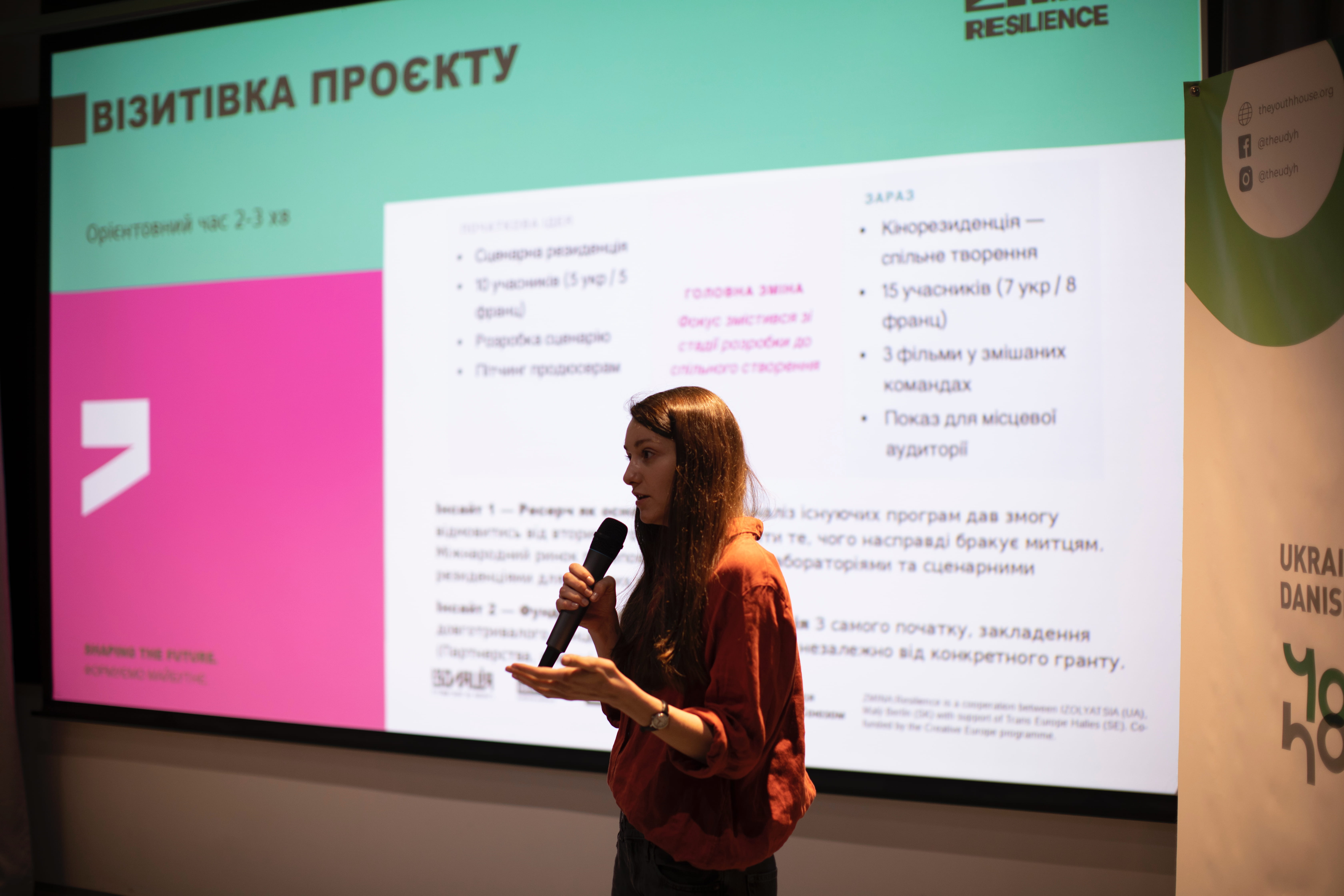
Inna Lastochkina, photo by Anastasiia Rozenberh
Revitalizing the Ukrainian film world with a French touch
The full-scale invasion has had a profound effect on Ukraine’s film industry. The disruption caused by the war has also reshaped this part of the country’s cultural sector, making international co-productions and collaboration with foreign partners becoming increasingly important.
Telling compelling stories alone is no longer enough. Professional networks, cross-border partnerships with international filmmakers — particularly producers — the ability to present projects convincingly, and the capacity to build long-term professional relationships have become just as essential.
On the France–Ukraine route and back
These are the needs that the Dialogue: Ukraine–France project developed by Contemporary Ukrainian Cinema seeks to address. The project's main objective is to establish an international film residency, bringing together fifteen emerging filmmakers from Ukraine and France.
During the residency, participants will work in mixed teams, guided by mentors from both countries, to develop their film projects. The programme places a strong emphasis on practical work. Participants will begin with an initial idea, develop it into a screenplay, and ultimately prepare a professional pitching package to present to producers.
The residency also aims to create a space in which participants can explore various filmmaking approaches and exchange practical experience. Filmmakers from Ukraine and France will share professional knowledge and receive feedback from experienced mentors.
In the final stage of the programme, participants will pitch their projects to domestic and international producers looking for new filmmaking talent.
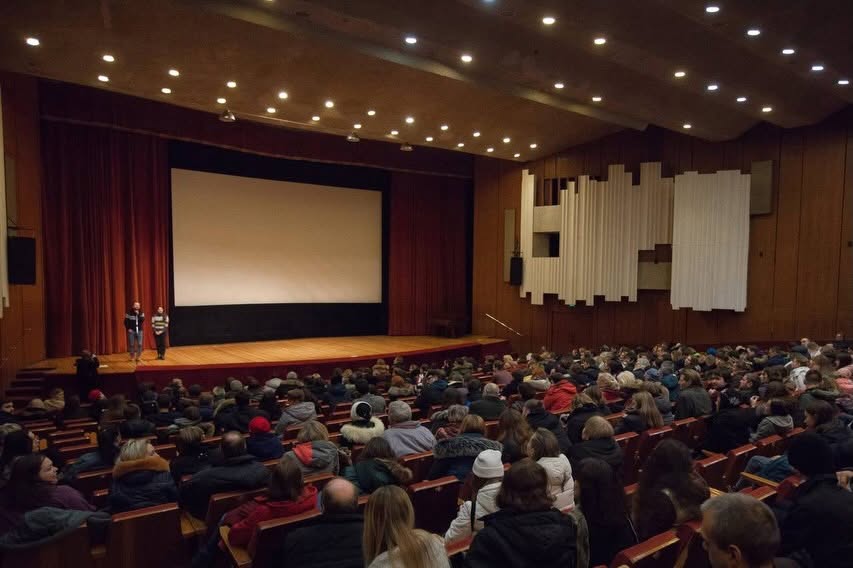
Cinema in Cinema house in Kyiv archive of Contemporary
Ukrainian Cinema
The Dialogue: Ukraine–France project supported by ZMINA:Resiliece framework will produce ten film projects, complete with screenplays and presentation materials. Equally important will be the creation of a network of professional contacts, partnerships and collaborations, which could lead to future international co-productions.
The initiative is led by Contemporary Ukrainian Cinema, one of the few Ukrainian organisations dedicated to systematic film education. Over the past eight years, the organisation has delivered numerous film festivals, film productions, workshops and masterclasses.
Until now, most of its activities have taken place at a local level. However, this new residency programme marks a significant step towards international exchange initiatives that could give Ukrainian filmmakers access to the European film industry.
Not just a one-off event
Before that vision can become reality, the organisers still face several challenges. Contemporary Ukrainian Cinema has limited experience in building international partnerships, developing residency programmes, and navigating European standards for cultural projects. For this reason, the organisation considers mentoring from experienced European partners, who have run similar initiatives for many years, to be essential. Another key objective is to create a sustainable long-term residency model.
The project was conceived by Inna Lastochkina, a producer who has worked with Contemporary Ukrainian Cinema since 2021 and has already contributed to the production of ten films. She says that it was during the war that she realised international partnerships could be built differently.
“When international co-productions became a necessity for Ukrainian filmmakers, collaboration with our European colleagues moved from the margins of our interest to the very centre of our work,” says Inna Lastochkina.
She deliberately chose to reverse the traditional model, in which organisations establish partnerships first and artists only meet afterwards. Instead, the residency is designed to bring filmmakers together through shared creative work, allowing long-term professional relationships to develop naturally from these collaborations.
One of the key inspirations behind the residency came from Inna Lastochkina’s previous experience of working with the French film industry. Over the past two years, she has been involved in developing several projects, which convinced her of the enormous creative potential that lies in bringing together filmmakers from Ukraine and France.
At the same time, she also became aware of the limitations of such collaborations. Although there is growing interest in Ukrainian cinema, she believes that genuinely strong and lasting professional connections between filmmakers across Europe remain relatively rare.
Lastochkina also points out that many European filmmakers have only a limited understanding of the current conditions for film production in Ukraine. At the same time, Ukrainian directors rarely have the opportunity to experience first-hand how the European film industry operates.
“The challenge is not artistic but practical – there are simply too few opportunities to work side by side,” says Lastochkina.
This, she says, is precisely why one of the residency’s primary goals is to create something that goes beyond a one-off partnership.
“Our aim is not a single collaboration, but to build lasting relationships between Ukrainian and French filmmakers that continue long after this particular project has ended.”
Two major challenges
The Contemporary Ukrainian Cinema initiative also seeks to address the broader challenges facing the emerging generation of Ukrainian directors.
“In my opinion, young Ukrainian filmmakers currently face two major obstacles. The first is the lack of a well-developed support system for emerging talent. This includes experienced mentors, film schools closely connected to the professional industry, and something even more practical – financial support and access to equipment during the learning process,” Lastochkina explains.
The second major challenge, she argues, is the isolation of Ukrainian filmmakers from the international film community. Many young directors develop within a relatively closed circle, working with the same colleagues, drawing on similar references and taking familiar creative approaches. They have too few opportunities to collaborate with filmmakers shaped by different traditions and production environments, or to explore alternative ways of thinking about cinema.
“Without this kind of exchange, it is difficult to broaden your perspective and understand where your work fits within the wider international landscape. You end up measuring yourself only against what surrounds you, rather than against the full potential of the filmmaking craft,” says the project's initiator.
For this reason, the organisers chose to build the residency in partnership with the French film sector, which has a long tradition not only of artist residencies but also of international co-productions and strong public support for cinema.
According to Lastochkina, French filmmakers have a wealth of experience in developing, financing and marketing films in Europe. She considers this to be one of the partnership’s greatest strengths.
“One of the most valuable things they can share is a culture of project development – the ability to give a project the time and attention it needs to mature before entering production.”
However, the exchange of knowledge is far from one-sided. According to Lastochkina, Ukrainian filmmakers also have a great deal to offer their French counterparts. Over the past few years, they have learned how to work under exceptionally challenging conditions, maintain professional standards under immense pressure and find creative solutions when resources and opportunities are limited. She believes that bringing these two different experiences together has the potential to create an environment in which both sides benefit.
First with the French, and later...
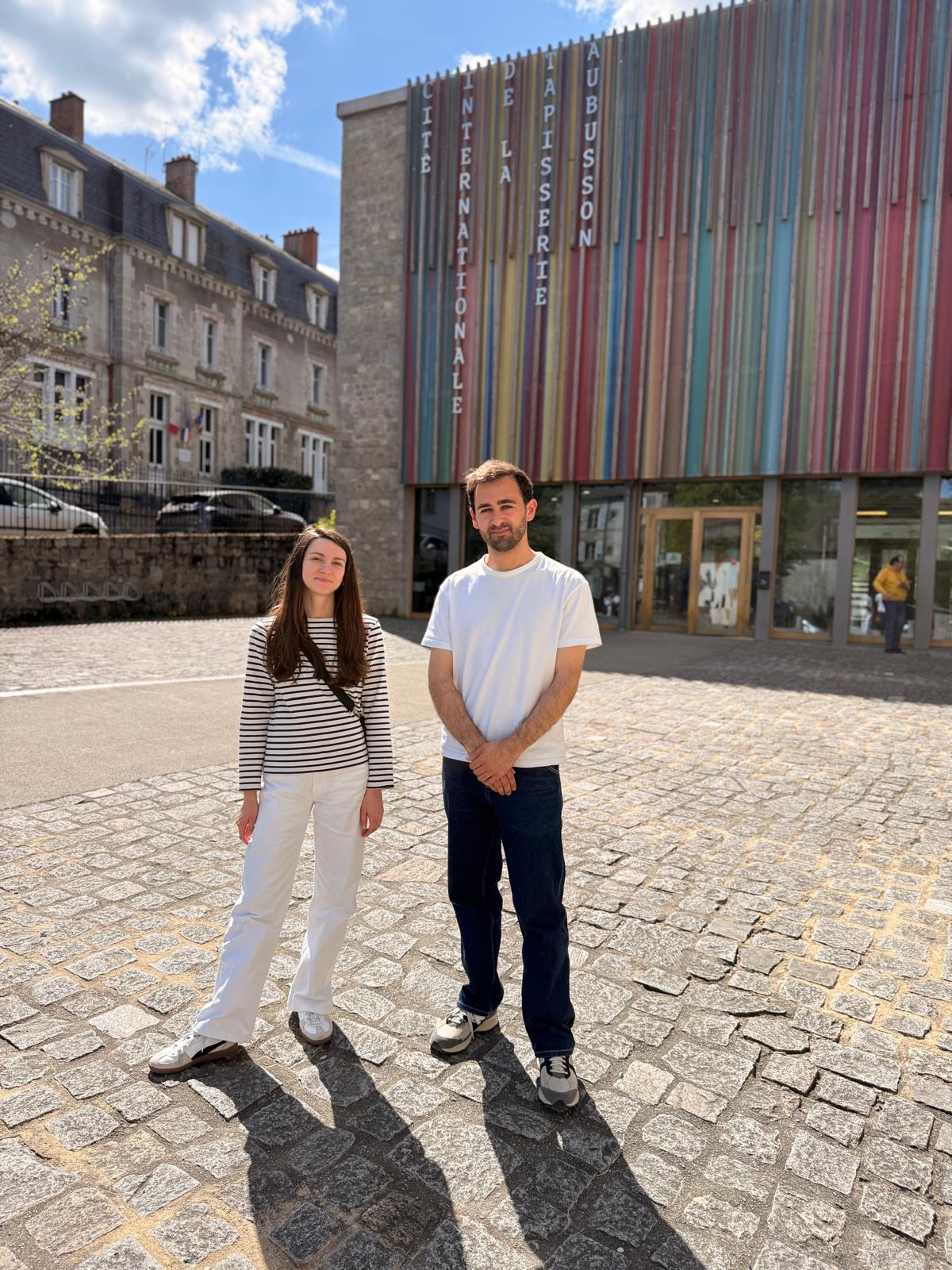
Quentin Just
The residency itself will take place in Aubusson, a town in France. Rather than attending a series of separate workshops, all participants will spend several weeks together. Lastochkina believes that this format provides the ideal conditions for building lasting professional relationships.
“My experience in the film industry has shown me that meaningful collaborations rarely begin in meeting rooms or at pitching events. They emerge when people spend time together, exchange ideas and build mutual trust. That is exactly what we hope to create through the Dialogue project.”
The residency’s professional programme has been designed with this philosophy in mind. The production strand will be led by French producer Quentin Just together with Inna Lastochkina. Just produced his first feature film at the age of 25, and it premiered at the Cannes Film Festival. Lastochkina, meanwhile, has extensive experience in international co-productions. Her latest short film, Unavailable, was produced as a co-production involving five countries and premiered at the Venice International Film Festival in 2025. The screenwriting development strand will be led by French director and screenwriter Céline Rouzet, whose debut feature was selected for the Orizzonti section at the Venice Film Festival.
The organisers intend to establish the residency as an annual event. The inaugural edition is scheduled for November 2026, pending the securing of the necessary funding.
“The real success of the project will be measured by the collaborations that continue long after the residency has ended – co-productions, creative partnerships, mentoring relationships and friendships that begin during just a few weeks of working together,” says Lastochkina.
In the long term, she hopes Dialogue will become a lasting bridge between Ukrainian and European filmmakers.
The original concept was different, however. The organisers had planned to hold part of the residency in Ukraine, particularly in its western regions. However, during the planning process, they encountered unexpected difficulties relating to travel for the French delegation. Consequently, they decided to hold the first edition entirely in France. Nevertheless, the project's partners visited Ukraine, including Odesa and Kyiv.
According to Lastochkina, they left with a very positive impression of the country and its film community. This has strengthened her determination to ensure that, in future, at least part of the residency takes place in Ukraine as originally planned.
Mentoring provided by the ZMINA:Resilience programme also played a crucial role in shaping the Dialogue: Ukraine–France project.
“For me personally, this process confirmed how important it is to have sufficient time and structured support during the early stages of developing a project. That is what enables future initiatives to grow stronger and become more competitive,” Lastochkina concludes.
Author: Ján Janočko
ZMINA: Resilience is a cooperation between IZOLYATSIA (UA), Malý Berlín (SK) with support of Trans Europe Halles (SE). Co-funded by the European Union. Views and opinions expressed are however those of the author(s) only and do not necessarily reflect those of the European Union or European Education and Culture Executive Agency (EACEA). Neither the European Union nor the granting authority can be held responsible for them.